S19 E8 – Fashion Crimes
I never said it was fair. I said it was usual. They are not the same thing.

Spoiler Warning: Do not read on if you haven't watched this episode!!
The past is never dead. It’s not even past. This line from William Faulkner’s 1951 novel Requiem for a Nun is never more apt than when Murdoch Mysteries tackles social injustice. Faulkner argued that we’re never fully free from what came before: All of us labor in webs spun long before we were born – and although workplace sexism may not be as blatant today as it was for women like Effie Newsome (Clare McConnell), it’s not dead and not even past.
Subtly underlined by the mention of the hobble skirt – whose real-life designer Paul Poiret famously said he freed the torso but shackled the leg – this episode is full of women who are being restricted, not just by their clothing but by men’s arrogance and condescension.
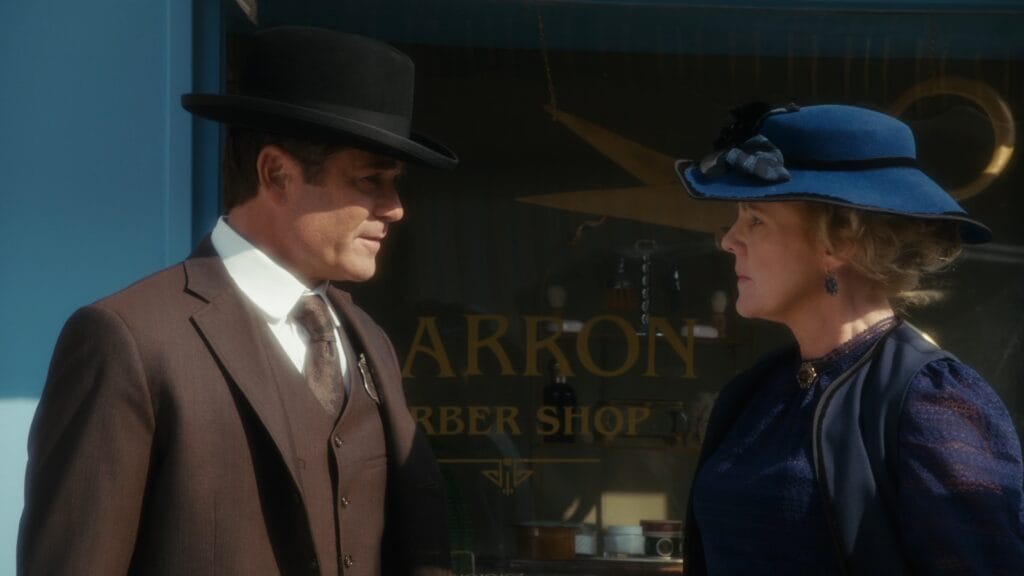
Effie is passed over for the job of Deputy Crown Attorney in favour of Roy Davenport (Cooper Levy), a man who may be quite the prodigy but can’t hold a candle to Effie. To add injury to insult, she is tasked with defending Joan Lewis (Nahanni Johnstone), whose guilt is a foregone conclusion: Your task is to guide Mrs. Lewis through the process of gracious capitulation. Effie, however, knows what her job is: It’s to work in my client’s best interests.
Grace is a Virtue
Surrounded as she is by men with varying degrees of misogyny, I was struck by Effie’s professionalism and the contrast between her conduct and Davenport’s. The latter, by turns smug, belligerent, and a sore loser, has no problem showing his disdain: Don’t worry. It shouldn’t be terribly difficult. Effie, on the other hand, remains civil, well-spoken, and simply good at her job. Grace is a virtue, and Effie has plenty of it.
As, in the end, has Detective Murdoch (Yannick Bisson). He may be progressive and well-meaning, but he’s still a child of his time and just a tad condescending when he tells Effie, Perhaps this time we shouldn’t let our emotions cloud our judgement. We, William? Still, he redeems himself when he eventually comes round to Effie’s point of view and helps her prove her client’s innocence by uncovering the real killer. Like Toronto’s Smartest Man, the episode closes on a playful exchange between Effie and Murdoch, with some friendly competition and mutual respect.
Expertly Framed
Meanwhile, Murdoch Mysteries’ other strong woman, Violet Hart (Shanice Banton), yet again has a man plotting against her. Her bar manager Ephraim Currant (Emmanuel Kabongo), once deemed indispensable to her neighbourhood safety program, is running a protection racket under the guise of that very community group. He manipulates Violet by telling victims she’s the one behind the operation and uses threats to keep her both silent and implicated in his crimes. Let’s be honest: she’s always been ambiguous enough that, once upon a time, this accusation might not have felt far-fetched. Expertly framed, indeed! It’s an exciting new storyline that should make for one or more great future episodes. Although, if I may give Miss Hart a bit of advice: hasn’t she learned anything from her father, her former business partner, and her husband? Ask your friends at the Constabulary for help already!
The very worst of the bad men in this episode is the one we never get to see: the murder victim, Marco Seraphim. He was no angel, his name notwithstanding. Seraphim stole the Sewmatron design from Xander Bach, built his empire using this machine while Bach died by suicide, hid his surviving son David away in an institution and lied to his family that the boy was dead at six, all while making him the face of the company. He fired Joan Lewis on the spot after catching her near an envelope full of money, refused to bail his daughter Valeria (Celia Owen) out when her business collapsed after the hobble-skirt lawsuits, and was, in Valeria’s words, a selfish cad who flaunted his wealth and never gave a dime to charity and had to have his arm twisted… to make him do what was right.
Tailormade
No wonder, then, that Murdoch and Effie go from one suspect to the next, logically examining their motives and the physical evidence. In a nice bit of 3D storytelling, writer Christina Ray sprinkles in little details that enhance the theme and the fashion-industry setting: the hobble skirt, the earring ruse, the Sterling Fashion Award scissors used as a murder weapon. Even Violet’s predicament has thematic relevance.
And speaking of fashion: with a title like Fashion Crimes, I figured costume designer Joanna Syrokomla and her team would have something to sink their teeth into, and I wasn’t wrong. Creating so many amazing outfits – not to mention all those hats! – for the main cast and the guest characters, episode after episode, is no small feat and is instrumental in making viewers feel it really is 1913. This time, in addition to the regular wardrobe, the team created a gorgeous off-the-rack line for the fashion-parade scene, with variations on a black-and-white pattern offset by several turquoise accents. I really can’t say enough about how this level of craftsmanship – here and in every episode – shapes the show’s texture and authenticity.
No Terra Incognita
At its core, the mystery itself is cleverly constructed and neatly sewn up (sorry, couldn’t resist!) by the final act, even if it leans on tropes familiar to long-time viewers. Murdoch has seen enough people standing over bodies with weapons in hand to know it’s practically proof of innocence – Murdoch of the Klondike, The Knockdown, and even his own ordeal in Hell to Pay come to mind. Likewise, the supposed death of a character who turns out to be alive is not exactly terra incognita for the series, nor is the notion of a wronged child becoming entangled in the family that harmed them. We’ve seen versions of this before: Downstairs Upstairs, The Curse of Beaton Manor. Mrs. Lewis’s fierce insistence on her innocence, followed by her change of plea, signals something else we’ve encountered before: that she’s protecting someone she loves.
Still, the hour moves briskly, and the emotional complications add texture. Through it all, director Mina Shum delivers an episode that is visually striking. I especially liked the camera angles in the jail scenes, where the stark cells and rigid lines of the cell bars create a compelling backdrop. So no, this isn’t breaking new ground – after nineteen seasons that’s a tall order – and it may not land on many top-ten lists, but it’s a solid, satisfying mystery all the same. Season 19 is shaping up to be a strong one indeed.
Bits and Bobs
This Episode's Hat: