S19 E6 – He Ain’t Heavy, He’s My Brother
My name is Choi

Spoiler Warning: Do not read on if you haven't watched this episode!!
A rich, ambitious A-story stitches geopolitics to brotherhood and lands a quietly devastating final beat for Inspector Choi (Paul Sun-Hyung Lee). Unfortunately, the tonal hopscotch of the B-story keeps elbowing the main story off its rhythm – leaving the episode not as strong as it might have been.
When a Japanese scholar (Hidetaka Ishii) visiting Toronto is abducted, Inspector Choi and Detective Murdoch (Yannick Bisson) are drawn into an investigation that reveals a covert Japanese plan to prepare military maps for a potential strike on American bases in the Philippines. The case brings Choi face to face with his estranged brother, Samuel (Jun Che), who appears to be a sympathizer for the Japanese Empire, but is in fact working in secret as part of the Korean independence movement. Samuel seeks to obtain a letter that proves Japan’s intentions, hoping to use it as leverage to gain American support for Korea’s sovereignty.
This premise allows writer Jenny Lee to explore a wealth of themes: sibling rivalry, pre–First World War expansion politics, questions of loyalty and betrayal, and the debate over whether freedom is won through force or through patience and diplomacy. At the same time, it’s one of those cheeky hidden history arcs the series likes to play with. Much like in last year’s The Men Who Sold the World, where an international conspiracy to cause World War I two years early was prevented, Samuel Choi thwarts the Japanese sabotage plan from ever unfolding, leaving the world timeline unchanged.
Geopolitics made personal
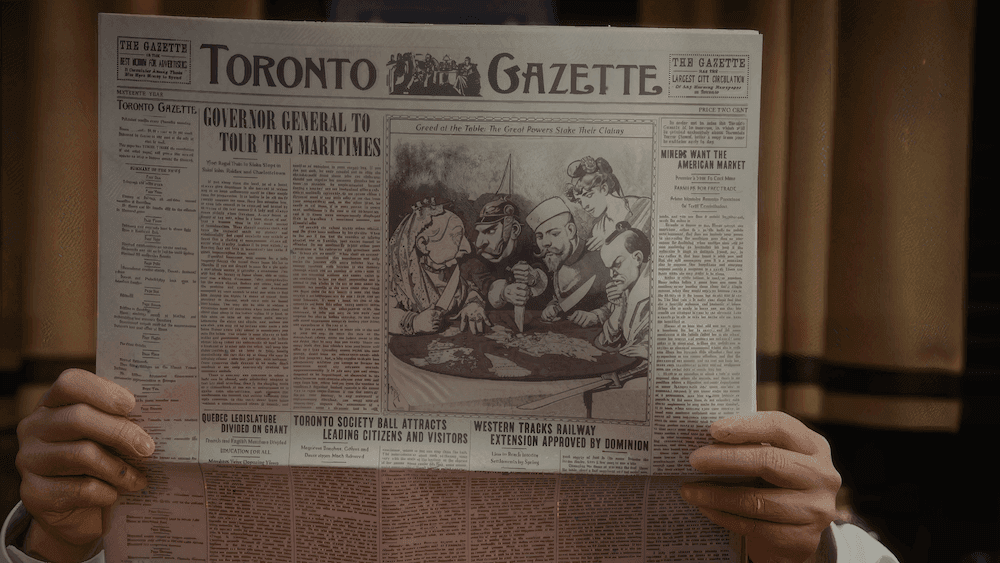
I was interested to learn more about the imperial powers carving out influence in Asia in the lead-up to the Great War – a subject I knew little about, as I suspect is true for many viewers. In true Murdoch Mysteries fashion, the subject is introduced with a wonderful Toronto Gazette cartoon with the caption Greed at the Table. The Great Powers Stake Their Claims. You have to applaud the time-consuming re-creation of a cartoon that looks very much like real historical cartoons from the time but is only shown for a second or so. It’s one of the things done well in this episode: the little things support and enhance the broader theme. This attention to detail recurs throughout the episode, notably in Murdoch’s interest in cartography and geodesy – neatly underscoring the global nature of the story – and the symbolic use of a compass as a murder weapon.
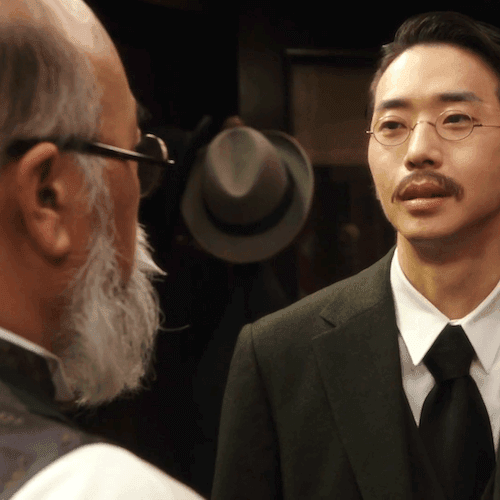
Set against this backdrop of great geopolitical turmoil, the story of the Choi brothers gives this episode its emotional centre and Paul Sun-Hyung Lee a chance to shine and show his dramatic chops. After his arrival on the Murdoch scene in the first episode of Season 18, we’ve seen small hints about Choi’s backstory and character, but in this episode he becomes a fully three-dimensional human being. We see him struggle with his brother’s taunts and reproaches – their sibling dialogue is especially well written and entirely believable, and Jun Che is excellent as Samuel – and we see the fear on his face that Samuel might even have a point about him having turned his back on Korea and his family. The confrontation in Choi’s office is particularly moving, as is the look on Choi’s face when his brother says My name is Choi, and, of course, the final tearful scene when Samuel turns himself in. The resignation letter gambit is classic Station House Four melodrama – who among the constabulary has not resigned out of guilt – but in an episode that shows how loyalties to country, family, and duty can be at odds, it feels consistent with the emotional and thematic arcs.
The Nitpicker’s Guide for Murdochians
I’m probably showing my age here, but when I was young there were these books for fans called The Nitpicker’s Guide for X-Philes and The Nitpicker’s Guide for Trekkies. Notwithstanding everything I liked about this episode, I feel it could fill a whole chapter in The Nitpicker’s Guide for Murdochians. There’s some sloppy editing – for example, when Choi meets his brother, Samuel nods twice in the exact same fashion. Conversely, it seems as if some scenes were cut that might explain a few things, like why Choi was suddenly drunk when he came home to find his brother’s letter – and how he was sobered up by the time he arrived at the civic square.
Plus, the script glosses over things that don’t hold up to scrutiny. Why should the investigation start by speaking to Christian missionaries who have spent time in Korea? Why did Father Radcliff (David Gingrich) lie? Why ask Detective Watts (Daniel Maslany) to translate the letter when you have a Korean native speaker on your team? Come to think of it, what was the purpose of that letter in the first place? And did the constables really need Murdoch’s fancy map to search every empty building?
The story’s biggest conceit is that Samuel is dead to Choi because he’s a traitor. In last season’s The New Recruit, he told Chief Constable Brackenreid (Thomas Craig) that his brother was not just dead, but killed when he joined a righteous army. I’m not sure if this was changed because it made for a better story, or if the writers already forgot what happened last year and are in dire need of a show bible (@Peter Mitchell, my email is at the bottom of this page).
A/B Story Format
For some reason, the main plot is interspersed with an unrelated B-story that is entertaining in its own right, but its tone does not mesh with the rest of the episode and, worse, disrupts the rhythm of the A-story and makes it harder to follow. Granted, it’s funny: I could listen all day to Brackenreid waxing poetic about whisky (or being a total snob, depending on who you ask), and Watts interacting with any type of liquor or liquid is a sight to behold. Ephraim Currant (Emmanuel Kabongo) catching the glass is very impressive indeed, and this exchange between Watts and Violet Hart (Shanice Banton) is perfection itself: Violet, perhaps you’d best hang back. These men may be dangerous. – And I’m not? I’m guessing Violet and Ephraim’s badassery is a set-up for coming episodes, and in most other episodes this B-story would have fit quite nicely. And Murdoch wanting to borrow Watts for an hour? Isn’t that his real job? In most episodes this would be charming enough, but here it only underscores the feeling that the B-story is ballast in an otherwise strong episode, made memorable by the quiet sorrow between the Choi brothers.
Bits and Bobs
This is the cartoon shown on the front page of the Toronto Gazette:

I thought I recognized that church, and sure enough: it’s the same as Rebecca James’ church in Season 9’s Colour Blinded.
This has Toronto’s biggest asterisk, but I believe the youth military school set up by an independence activist refers to Park Yong-man, who established a military school in Kearny, Nebraska.
Well, it only took 19 years, but Brackenreid finally joined Murdoch at a scientific conference. Of course, he was only after a nice map of England and moved to the bar at the earliest opportunity, but still.
This Episode's Hat: