S19 E17 – The Hunting Lodge
And Then There Were None (Well, Two)

Spoiler Warning: Do not read on if you haven't watched this episode!!
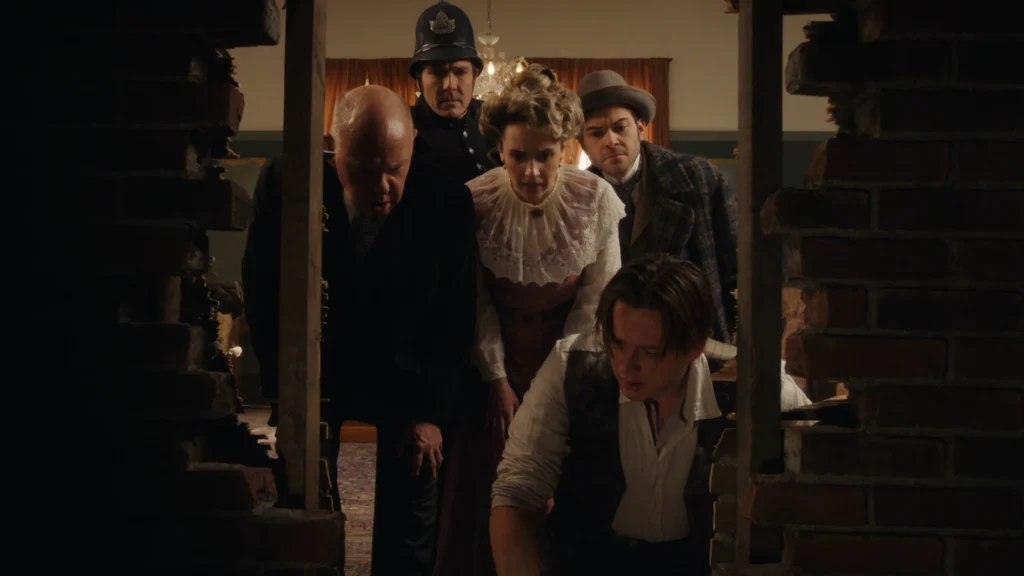
It’s another busman’s holiday for a Murdoch Mysteries character in this thrilling take on the iconic Agatha Christie novel And Then There Were None. Much like the novel, The Hunting Lodge features a wonderful ensemble cast trapped in a remote location, dying one by one in a tense, suspenseful plot that combines elements of a murder mystery, psychological thriller, and slasher. But unlike in the novel, the victims’ guilt here is far more ambiguous – and even the titular detective comes dangerously close to making a fatal error.
Writer Saleema Nawaz certainly knows her classics. As in last season’s What the Dickens?! she has taken key elements from her reference material – in this case the high tension and paranoia, fast-paced narrative, and psychological elements – and has moulded them into exactly the kind of story this show does so well.
Busman’s Holiday
As Chief Constable Brackenreid (Thomas Craig) goes on a retreat with some of his fellow inspectors, only for events to take a deadly turn, The Hunting Lodge will remind long-time viewers of Murdoch Mysteries episodes like Friday the 13th, 1901 and The Cottage in the Woods – except this time it’s all male and there’s a lot less screaming. I must confess this type of episode usually doesn’t make my all-time favourite list. It’s not that I mind the conceit that wherever a cast member goes on holiday there’s a murder. The busman’s holiday is one of the oft-used tropes for murder mystery shows, right up there with the detective’s hometown having an unbelievable death rate per capita. If you can’t suspend that particular disbelief, mystery shows are not for you. No, the reason I tend not to enjoy them all that much is that they are usually very Murdoch-lite. What can I say, I like my Murdoch Mysteries to be about Detective Murdoch (Yannick Bisson). So it’s saying a lot about the quality of the script and the guest cast that I did immensely enjoy this week’s episode.
Brackenreid’s fellow inspectors are an eclectic bunch. It’s a mark of good writing as well as good acting and directing (by Craig Wallace) that their characters are quickly established, with distinguishable traits without making caricatures of them. Lester Dawes (Robert Verlaque) is loud and already into the whisky. Lots of subtext here: he’s the one who closed the Holyrood case – a real house of horrors – so no wonder he became a drinker. George Washburn (Douglas E. Hughes) is portrayed as a martinet who wants everything done properly and on time. Neil Moser (Don McKellar) is quite belligerent, right up until he gives up the ghost. Ed Cleasby (Bob Bainborough) is a worrier and a bit of a mother hen. Moser thinks him a sentimental fool – later we find out that Cleasby had an affair with Moser’s wife, and that the two had once been partners. And finally, of course, Patrick McKenna reprises his role as Hamish Slorach, whom we first met in Season 3 and who has made the occasional appearance since. Thankfully, the writers remembered that he was shot in the ear in Season 12 – although they appear to have resurrected his dead wife!
What Makes a Good Policeman?
I like that Slorach is still as bumbling (but honest and upbeat) as ever. He freely admits that he thought the Simcoe Slasher was behind the murders at the cabin pretty much the whole time. It’s hilarious to see how not just Slorach but all of them keep circling back to the Slasher, no matter how much evidence to the contrary they find. Or perhaps not hilarious at all – but a sign of how unwilling they are to face their own culpability? Either way, it’s Slorach who turns out to be the better cop – because he cares. He knows that Dawes had pills for his heart problem. He says Widow Garriton can’t be behind the cabin killings because she is nearly 70 and very frail. He knows that Chadwick Vaughan and his wife reconciled and left for Paris a couple of weeks ago. He remembers the friendly vagrant who was killed by the Simcoe Slasher. He can list all the 206 Holyrood victims. And he remembers the name of Constable Lindfield’s (Theo Vandergraaf) mother.
This question of what makes a good policeman serves as a persistent subtheme throughout the episode. Lindfield may have left his studies in Engineering to join the Constabulary because of Murdoch, but according to Slorach and Brackenreid, behind every great detective there’s an even greater inspector. However, when Brackenreid is accused of trying to playact the great detective and of having risen to be Chief Constable all thanks to Murdoch, he doesn’t deny it but says at least I’ve always supported the detectives under my command. Perhaps it’s about knowing one’s strengths? Brackenreid is shown here to have the right instincts, but he doesn’t put it all together until very late.
Moral Culpability
In And Then There Were None, every one of the victims was responsible for a death, though many would not be legally classified as murder in a traditional court. Here, Lindfield is seeking revenge for the death of his mother by the Holyrood killer, a death that could have been prevented by everyone who should have put the Holyrood killer away but didn’t. Arguably, these inspectors weren’t responsible for any deaths, not even indirectly – although Moser comes close to having moral culpability because he stitched up a black man for a murder committed by the Holyrood killer and forced Cleasby to cover for him. The others, however, are at best guilty of blunders and ignorance. As such, the episode seems to be a plea for Murdoch’s careful brand of policing. After all, he caught the Slasher by doing paperwork. Except, he could easily have made a similar type of mistake. Murdoch’s face, eloquent with anxiety over miscalculating the dosage of knockout gas and thus killing two men, tells you all you need to know.
The Hunting Lodge is a gripping story and works best when it focuses on the escalating fear and mistrust among the characters as they realise they are being targeted and the murderer might very well be one of them. The murder methods are ingenious, and Lindfield obviously is as adept at psychology as he is at electrical engineering: he cleverly plants the idea of the Slasher in Brackenreid’s and Slorach’s heads. The deaths are a bit more violent and gruesome than usual, and there are more police funerals in a month than we’ve seen in many a year – as is fitting for the slasher genre.
Fast-Moving and Suspenseful
Not that the script is without its flaws. For one, there are some convenient coincidences: someone snags on a sheet to uncover a telegraph machine just as they need to send for help; Murdoch just happens to have the one file in his hands that helps crack the case; Lindfield not only reviewed the files about the 206 Holyrood killings but also the surely obscure file on Coot Newton’s erratic driving? For another, some hard-to-explain things are simply glossed over – like how did the killer manage to move the body of Inspector Dawes from the cold room and prop it up against the door when all the doors and windows were locked or nailed shut? And if it was Inspector Moser who arranged for a car, how did Constable Lindfield end up behind the wheel?
Through pace and editing and music, these contrivances – if you want to call them that – are mostly covered up. It’s so fast-moving and suspenseful that you don’t have time to think that Lindfield is of course the only possible killer. It also helps that this is a young, bright-eyed and dimpled constable – though on rewatch, you’ll notice how Lindfield’s expression very subtly and ever so fleetingly hardens when Slorach mentions the killings at 206 Holyrood. The Hunting Lodge is as good as it gets, a worthy homage to And Then There Were None, and a suspenseful mystery-thriller in its own right.
Bits and Bobs
This Episode's Hat: