S19 E11 – Strangers on Paper
A puzzle without a picture. The best kind.

Spoiler Warning: Do not read on if you haven't watched this episode!!
In his first solo outing, writer Nick West delivers a classic Murdoch Mysteries episode with more than one nod to modern-day dilemmas and debates. Filmed in beautiful locations in Hamilton, Ontario, and boasting several very strong supporting roles, Strangers on Paper explores what makes our favourite characters tick. And no matter how level-headed they are, no one is entirely immune to flattery, attention, charisma, and persuasive rhetoric.
At first glance, the episode’s two storylines – the murder of a man selling mechanical equipment via a classified ad, likely strangled with the very item he advertised, and Louise Cherry’s (Bea Santos) and Effie Newsome’s (Clare McConnell) ventures into personal ad dating – seem connected only through the community newspaper. Dig a little deeper, though, and a couple of thematic throughlines emerge: how easily we fall for a compelling narrative, what motivates the characters’ actions and choices, and the tension between science and fact-free belief.
Brain Worm?
Much like he and co-writer Peter Mitchell did in last year’s When Irish Eyes are Lying, West transports today’s cultural and political climate to 1913 (or is it 1914? – who knows at this point) Toronto. Where today we have to contend with Robert F. Kennedy Jr. destroying scientific institutions, pulling research funding, sowing doubts about vaccinations, and pushing to roll back public health recommendations for drinking water, Murdoch’s world has the aptly named Kimbal Vanderwell. Jake Epstein returns in another charismatic-but-untrustworthy role, following his turns as con man Charles Ponzi in Home for the Holidays and George’s duplicitous friend Eddie Driscol in Murdoch Night in Canada.
Vanderwell, a businessman from the Congo clad in an ostentatious colonial-style cream suit and black turtleneck, is campaigning against the addition of chlorine to Toronto’s water. He has managed to convince most of the city’s la-di-das to pull funding from research facilities, forcing these laboratories to abandon promising medical research. He’s also putting arsenic in his own brand of bottled water. At least RFK Jr. has that brainworm – what’s Vanderwell’s excuse? Oh, wait: I would be charging a fee.
(Evil) Genius
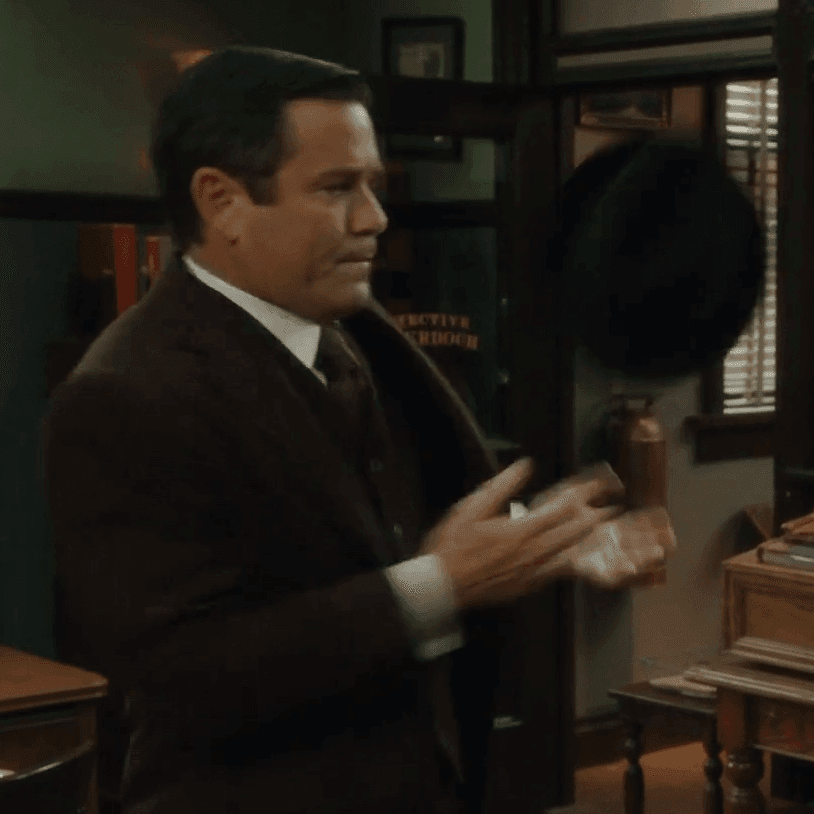
The episode opens with a very funny scene – most of the fun provided by Detective Watts (Daniel Maslany) – where Murdoch is improving the modern toaster for his son. This effectively sets him up as a contrast to the killer, who also is a bit of a tinkerer, but may be an evil genius. Of course, the killer ultimately proves more pathetic and desperate than evil, and Murdoch talks him down from poisoning the water supply to the elite Rathnelly neighbourhood by appealing to his scientific mind.
Understanding why protagonists act the way they do is an important part of storytelling, and West does a great job letting the characters’ motivations drive the story. Murdoch, as we know, is driven by scientific curiosity (You’re off to the laboratory? You don’t think I’d pass up that opportunity, do you?). He simply loves puzzles, and doesn’t suffer pseudo-scientific politics gladly, as shown by his thoroughly researched presentation to City Council.
To the Backenreds!
Perhaps unexpectedly, it’s Margaret Brackenreid (Arwen Humphreys) whom the episode explores most deeply. She’s always been a dogged social climber, but her reference to Mayor Vaughan gives us new insight into why she’s so determined for her husband to climb the social ladder: Need I remind you that your lack of friends in high places nearly derailed your career? If you had had the right friends, then Chadwick Vaughan would have never been able to jostle you about.
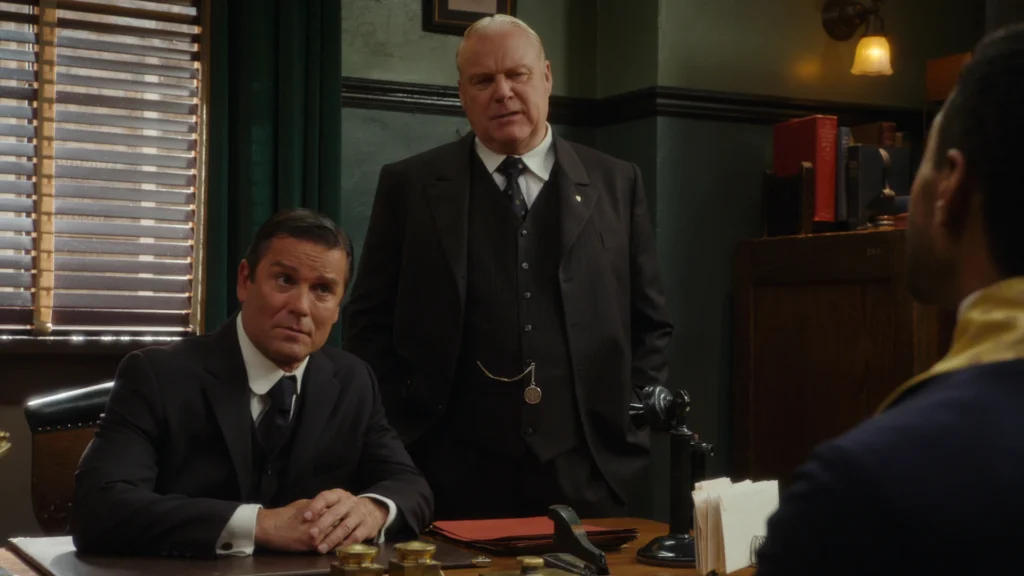
Thomas Brackenreid (Thomas Craig) is a much simpler man: I just want to taste quality whiskey in the Castle Heights lounge and then spank Greg Gleaton’s arse on the bowling green. He looks right through gobshite Vanderwell, but is still tickled when the latter compliments him on his (well, Watts’) selection of wine. To the Backenreds!
Jeez, Louise!
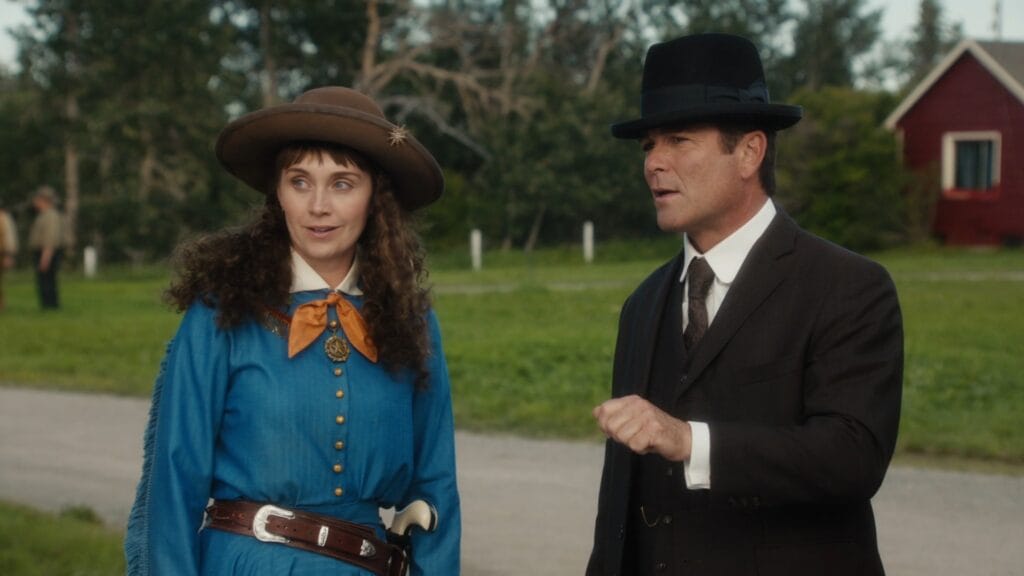
Meanwhile, it turns out Louise Cherry isn’t exactly immune to a bit of glib-talking either. She may be hardboiled – poor Mavis (Megan Murphy) – but she is absolutely naïve when it comes to men. Her track record isn’t great: she drove away George Crabtree, was engaged to a two-timing married murderer and to a film director who died, was stalked by a co-worker, and recently had a thing for a Spanish cobbler only to find out he was already married. Falling for Sidney Ballard’s (Chris Tomassetti) incredibly obvious dating-profile inflation certainly fits that pattern. I liked that he turned out not to be the swindler she thought he was – still a cad, though. And I liked that Effie started to fall for his divorce story despite her own scepticism. But I especially liked how we got a little insight into Louise’s insecure soul, that’s usually hidden by her tough exterior: Well, you need to tell Detective Murdoch. I can’t. You know how they see me down there. They’ll get a good laugh knowing that Louise Cherry fell victim to some simple grift.
Beyond the main players, the supporting cast does excellent work bringing depth to both storylines. West’s sharp writing and Duane Crichton’s assured direction give each supporting character a distinct personality, and the actors rise to the occasion. Catherine McNally and Dennis Cutts are memorable as the obnoxious McPhersons, while doctors Noble (Jason Jazrawy) and Pipkin (Nabil Traboulsi) demonstrate that appearances deceive: the quiet one proves dangerous, while the irascible one is merely protective of his work. Adam Wallace Downey brings righteous anger and impatience to his character Errol Moncrief. Carson Durven and Dorrett White also shine as talkative Robert Stockton and his no-nonsense daughter Martha.
Puzzle Solved
Strangers on Paper succeeds as a character-motivation-driven storyline that rewards close attention. West and director Crichton clearly understand these characters and know how to use them effectively – impressive given both are relatively new to Murdoch Mysteries. The episode’s construction is elegant, with rhyming elements like the tinkerers and classified ads connecting the parallel storylines. When the City Council silently corks Vanderwell’s poisoned water bottles, it’s a perfect visual moment: reason and evidence win without a word spoken.
The episode is also genuinely funny, particularly in its Watts moments. His deadpan toaster commentary – I don’t visit you on weekends – lands perfectly. Higgins (Lachlan Murdoch) gets a showcase too, fully committed to his undercover factory-owner role and hilariously trying to turn an actual profit. The bicycle chase that actually catches a car is pure Murdoch Mysteries charm. The assembly montage, always a pleasure, features the usual superb music accompaniment.
Vanderwell makes an excellent villain even though he’s not the killer. The episode’s only real stumble is never explaining why Pipkin wouldn’t simply purchase the equipment rather than resort to theft and murder – but fine, we’ll go with that, otherwise this best kind of puzzle wouldn’t exist.
Bits and Bobs
This Episode's Hat: