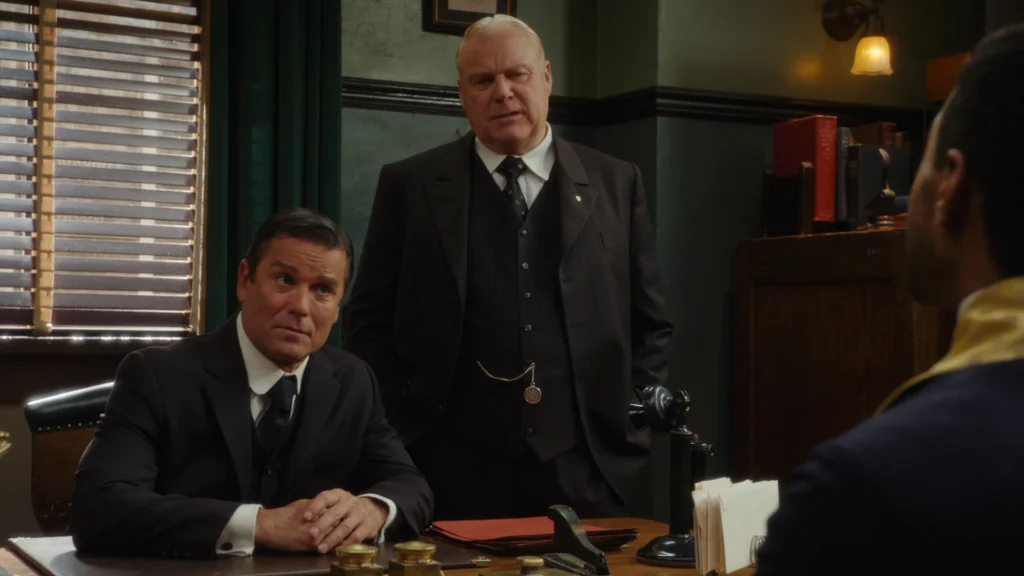
S19 E13 – Murdoch in Hogtown
Jeez, Louise, another dead man?!

Spoiler Warning: Do not read on if you haven't watched this episode!!
Murdoch in Hogtown works best when it highlights the parallels between its two lead investigators. Usually portrayed as adversaries – or at least mutual annoyances – Detective William Murdoch (Yannick Bisson) and journalist Louise Cherry (Bea Santos) are revealed here to be cut from the same cloth. Both pursue truth with dogged determination that occasionally crosses into tunnel vision. Both jump to conclusions based on their preconceptions. And both, ultimately, get there in the end, even if ‘there’ turns out to be somewhere quite different than they initially imagined.
In what begins as two separate investigations and storylines, Miss Cherry is going undercover as a sausage maker at the Wexler Davies meat-processing plant to expose deadly workplace safety violations, while Murdoch investigates a bank robbery. Jenny Lee’s script uses these investigations to explore their motivations. And while she may paint the detective and the reporter with the same brush, Miss Cherry is her usual gung-ho self – anything for my readers – but Murdoch is uncharacteristically close-minded.
This season has given several of the recurring cast the opportunity to shine and add depth to their characters: Inspector Choi in He Ain’t Heavy, He’s My Brother, Constable Roberts in Unearthing the Past, Constable Higgins in Tow Tags. Murdoch in Hogtown gives similar screentime to Louise Cherry, but does little to develop her character. From the way she lets herself get flattered into taking on this case – I read all your articles. You’re a great investigator – to using Miss Hart (Shanice Banton) as her personal coroner to conjuring a compelling but completely false story out of a single jawbone, this is the journalist we’ve always known. Not exactly likeable, but very driven and very funny, she mainly serves to forward the story. Her interactions with some of the other characters are hilarious, especially the ones with hero-worshipping Mavis Cain (Megan Murphy): You smell like sausages. It’s a nice smell.
Toronto’s Smartest Man
Murdoch, on the other hand, is showing a side of himself we haven’t often seen. There’s something about François Boudreau (Lindsay Owen Pierre) that brings out the worst in him. The moment Murdoch notices Boudreau loitering near the scene of the crime, he makes up his mind that he is guilty, and no matter how circumstantial or even exculpatory the evidence, he remains convinced and refuses to entertain alternative theories. In Murdoch’s defence, Boudreau goes out of his way to provoke the detective. As we learned in Toronto’s Smartest Man, ever since Murdoch arrested him ten years ago, he’s been waiting for the day that I could throw your supposed genius back in your face. His presence at the first crime scene may have been coincidental, but every other time Murdoch notices him, it’s clear to anyone but Murdoch that he is being trolled.
Yannick Bisson brilliantly shows how Boudreau gets under his skin in a way even former nemeses like James Gillies and Ralph Fellows couldn’t. Murdoch may rationalize this in his philosophical discussions with Detective Watts (Daniel Maslany) and maintain that a leopard does not change his spots, but it’s obvious that he simply does not like it when his intellect is challenged. It makes for thoroughly enjoyable situations and dialogues, none more so than the scene where Watts nudges Murdoch into making an apology like he’s a reluctant child who kicked his ball through the neighbour’s window. By episode’s end, Murdoch offers Boudreau a position as a criminal informant on miscellaneous deplorable topics. It’s a role we haven’t really seen on the show before, and it opens up interesting story possibilities. From Boudreau’s smug acceptance – I guess I’d never turn down the opportunity to make you admit that I know something you don’t – we’ll almost certainly see him again. Good.
Scientific Mind
Fortunately, Murdoch’s scientific mind is anything but closed. I love how, in the midst of yet another chest-thumping match with Boudreau, he casually puts the jawbone from the meat grinder under the microscope and dismisses Miss Cherry’s theory: The shapes of these osteons are far too irregular. This is definitely not human. And he may be a bit slow on the uptake when he and Cherry find themselves trapped in a storage room with twenty litres of nitroglycerin (Don’t tell me we’re trapped. – Alright. But we are.), but he does succeed in desensitizing the explosive substance by doing some quick mental arithmetic: he dilutes the nitroglycerin with the right amount of ethanol that happens to be on hand. At first, this felt like a deus ex machina, but ethanol genuinely is used in certain types of soapmaking, so I’ll allow it. And while we’re fact-checking: I happen to be married to a chemical engineer (hi, honey!), and he assures me that Murdoch’s calculations are mostly accurate, given that he did them in his head.
From the moment all protagonists converge in the morgue – which, incidentally, looks more like an abattoir than the actual abattoir – both Murdoch and Cherry turn out to be working on the same case. However, it’s not the corporate malfeasance she expected, and it’s not the perpetrator he suspected. Rather, the first dead man worked himself to death, the second dead man accidentally blew himself up, and the culprits turn out to be disillusioned meat cutters whose jobs didn’t pay enough to provide for their families. The only real killer – who killed the vegetarian activist documenting conditions at the plant – acted out of concern for the company and the job he was immensely proud of. With a name like Chuck (Peter N. Bailey), I really should have seen that coming.
Silk Purse out of a Sow’s Ear
Murdoch Mysteries‘ depiction of the meat processing industry is enough to put anyone off their meat (though apparently not Louise Cherry, despite knowing exactly how the sausage is made). Between this episode, Season 11’s Crabtree à la Carte and Season 17’s Station House of Horrors, Toronto certainly earns the nickname Hogtown. Writer Jenny Lee, director Craig Wallace, the set dressers, and costume designers do a good job in evoking pre-World War I Toronto. The Wexler Davies Company nods to real history: William Davies, a British immigrant, opened a pork-packing business at Toronto’s St. Lawrence Market in 1854, eventually creating the peameal bacon sandwich that became a signature Toronto dish. It’s this kind of historical detail that Murdoch Mysteries does so well, grounding even its more outlandish plots in the textures of period Toronto.
This is a very enjoyable episode, but it suffers slightly from a sense of déjà vu. We’ve been to a meat-processing plant before, we’ve watched Miss Cherry enjoy her meat at the end of an episode. Murdoch has misjudged someone based on prejudice before. Even the holes in the walls of the banks reminded me of an earlier episode (The Incredible Astonishing Adventures of Constable George Crabtree). For casual viewers, this likely isn’t a problem. The episode works perfectly well on its own merits, building on Toronto’s Smartest Man and giving Boudreau a satisfying return. But for diehard fans, the familiarity may dull the impact somewhat. Other than that, I am only left with one question: how did the soap makers usually exit the storage room if its closet lock can’t be opened from the inside?
Bits and Bobs
This Episode's Hat: